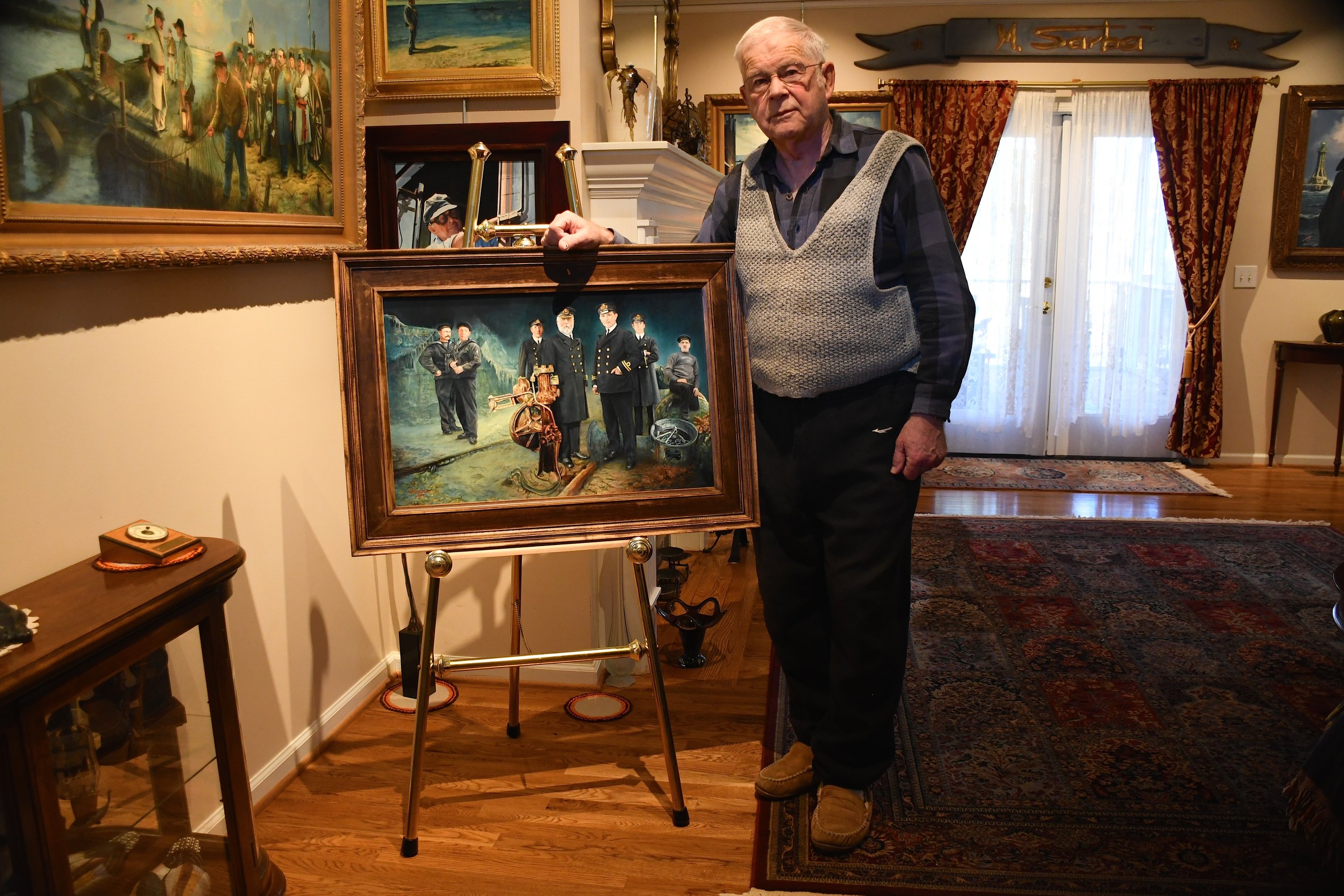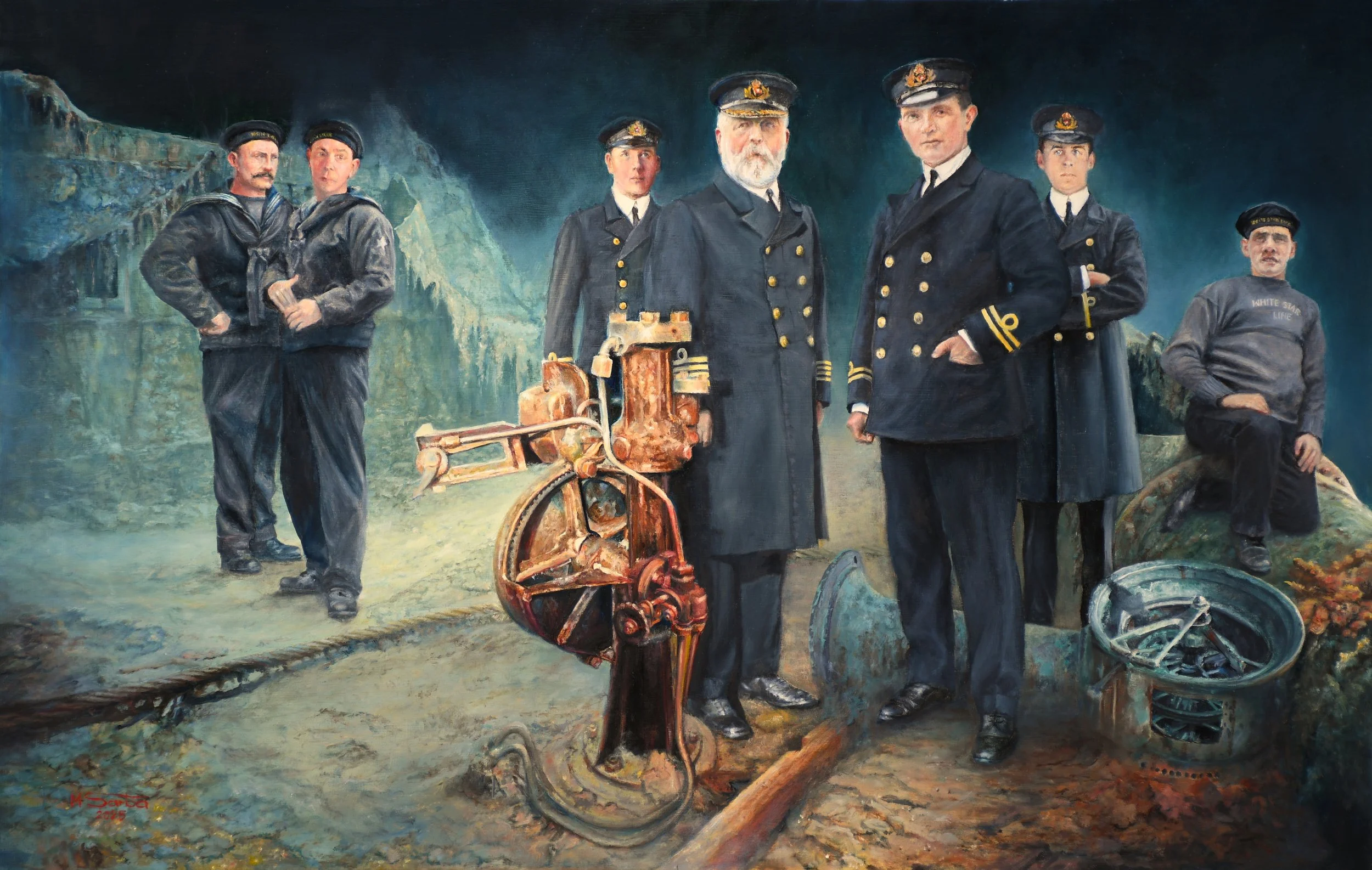
The Last Watch, RMS TITANIC, c. 1912
oil on panel, 17 ½” x 27 ¼”
$20,000
~ From the left: Quartermaster Alfred Olliver, Quartermaster Robert Hichens, Sixth Officer James Paul Moody, Captain Edward John Smith,
First Officer William McMaster Murdoch, Fourth Officer Joseph Groves Boxhall and the Lookout Frederick Fleet. ~
After a long period of time, I decided to create my third painting on the RMS “TITANIC.” The project took a long time to come to fruition. My choice was the ship's command post, meaning the Bridge and Wheel House, places that I know very well from my personal work at sea. There is also one of the monumental remains of the ship more than 100 years after the sinking, a silent witness, the telemotor column. I decided to bring to the place of the last watch all those who were on duty to guide the ship and with whom the tragedy began. The warning sounded by midwatch lookout, Fred Fleet, who called to the TITANIC's bridge from the crow’s nest, “Iceberg right ahead!” is indelibly frozen in history. A narrow pass on the surface, a gentle bump below the water line, and for the next two hours and 20 minutes, the most magnificent sea-going vessel ever built, and 1,522 of her passengers and crew waited to die.
The elements added to the bridge scene are: a telegraph which is one of the symbols of the situation and a part of the bow mast which was a place for lookouts and mainly for adding the Lookout, Frederick Fleet. The post-accident investigation did not place blame on anyone personally and I am not drawing any conclusions. I just brought the whole watch crew in to look at their final result. This is a portrait of the characters of this event.
Detailed descriptions of the crew members portrayed can be found everywhere, so I will only provide very simple transferred references.
The Lookout, Frederick Fleet (October 15, 1887 –January 10, 1965), was a British sailor who at 23:39 (11:39 pm) spotted the iceberg and rang the nest's bell three times to warn the bridge of something ahead. Then, using the nest's telephone, he contacted the bridge. It was answered by Sixth Officer James Paul Moody, who asked Fleet immediately, "What did you see?" He pronounced the infamous "Iceberg! Right Ahead!.” He survived the sinking of the TITANIC. Fleet's wife died, and on December 28,1964, and on January 10, 1965, Fleet died by hanging himself in his brother-in-law's house's garden. He was 77.
Quartermaster Alfred John Olliver (June 2, 1884 –June 18,1934), was a sailor from Jersey who was one of seven quartermasters serving on RMS TITANIC. Olliver had been at the ship's wheel until 10 pm at which time he was relieved by Robert Hichens. He then was running messages from the officers and was just returning to the wheelhouse at the moment of the collision and he heard the First Officer's command "Hard Aport.” He survived the sinking of the ship and the tragedy emotionally affecting him, never worked at sea again. He died on June 18, 1934 in St Saviour, being buried in an unmarked grave. He was only 50.
Quartermaster Robert Hichens (September 16, 1882 –September 23, 1940), was a British sailor one of seven quartermasters on board the vessel, he was at the ship's wheel when the TITANIC struck the iceberg. He survived the sinking of the ship. On September 23, 1940, at age 58, Hichens died of heart failure aboard the ship ENGLISH TRADER.
Sixth Officer James Moody, (August 21, 1887 –April 15, 1912), was a British sailor. After spotting the iceberg, Lookout Frederick Fleet rang the warning bell three times and phoned the bridge. Moody picked it up immediately but did not say anything. An anxious Fleet asked, "Is anyone there?" "Yes", Moody confirmed, "What did you see?" Fleet replied, "Iceberg, right ahead!". Moody said politely, "Thank you," and relayed the warning to Murdoch: "Iceberg right ahead!," Murdoch ordered, "Hard to port!,” Moody standing with Robert Hichens repeated the command "Hard a-starboard. The helm is hard over.” Sixth Officer James Moody died when the ship sank.
Captain Edward John Smith (January 27, 1850 –April 15, 1912), was an English sea captain. On April 14, 1912, TITANIC's radio operators received six messages from other ships warning of drifting ice, which passengers on TITANIC had begun to notice during the afternoon. Although the Captain was aware of ice in the vicinity, they did not reduce the ship's speed and continued to steam at 22 knots (41 km/h; 25 mph). At around 10 p.m., Smith went with Fourth Officer Joseph Boxhall to the chart room, where Boxhall gave Smith the ship's position and then went to his cabin. TITANIC collided with an iceberg at 11:40 p.m. - the captain felt it and arrived on the bridge where he was informed by Second Officer Murdoch that he had struck an iceberg. Captain Edward John Smith died with his ship.
First Officer William McMaster Murdoch (February 28, 1873 –April 15, 1912), was a British sailor who was the officer in charge on the bridge when the ship collided with an iceberg. Moody passed Fleet's warning to First Officer William McMaster Murdoch who ordered the helm "hard to port" to ward off the stern of the iceberg. Fourth Officer Boxhall testified that Murdoch set the ship's telegraph to "Full Astern", but Greaser Frederick Scott and Leading Stoker Frederick Barrett testified that the stoking indicators went from "Full" to “Stop". After the collision, Murdoch raced towards the watertight door controls, in the open bridge, and signaled the alarm below. Murdoch then told Quartermaster Olliver to "take the time," and told one of the junior officers to "make a note" in the logbook. Murdoch was responsible for the ship and all its passengers during that time and he perished when the ship sank.
Fourth Officer Joseph Groves Boxhall Jr. (March 23,1884 –April 25, 1967), was a British sailor who was on duty but was not on the bridge in the moment of collision. Hearing the lookout bell, he headed immediately to the bridge, arriving just after the impact. Boxhall died on April 25, 1967 at the age of 83. His body was cremated and his ashes were scattered to sea at the position he had calculated as TITANIC's final resting place . Boxhall was the last surviving former officer of the TITANIC.
~Marek Sarba